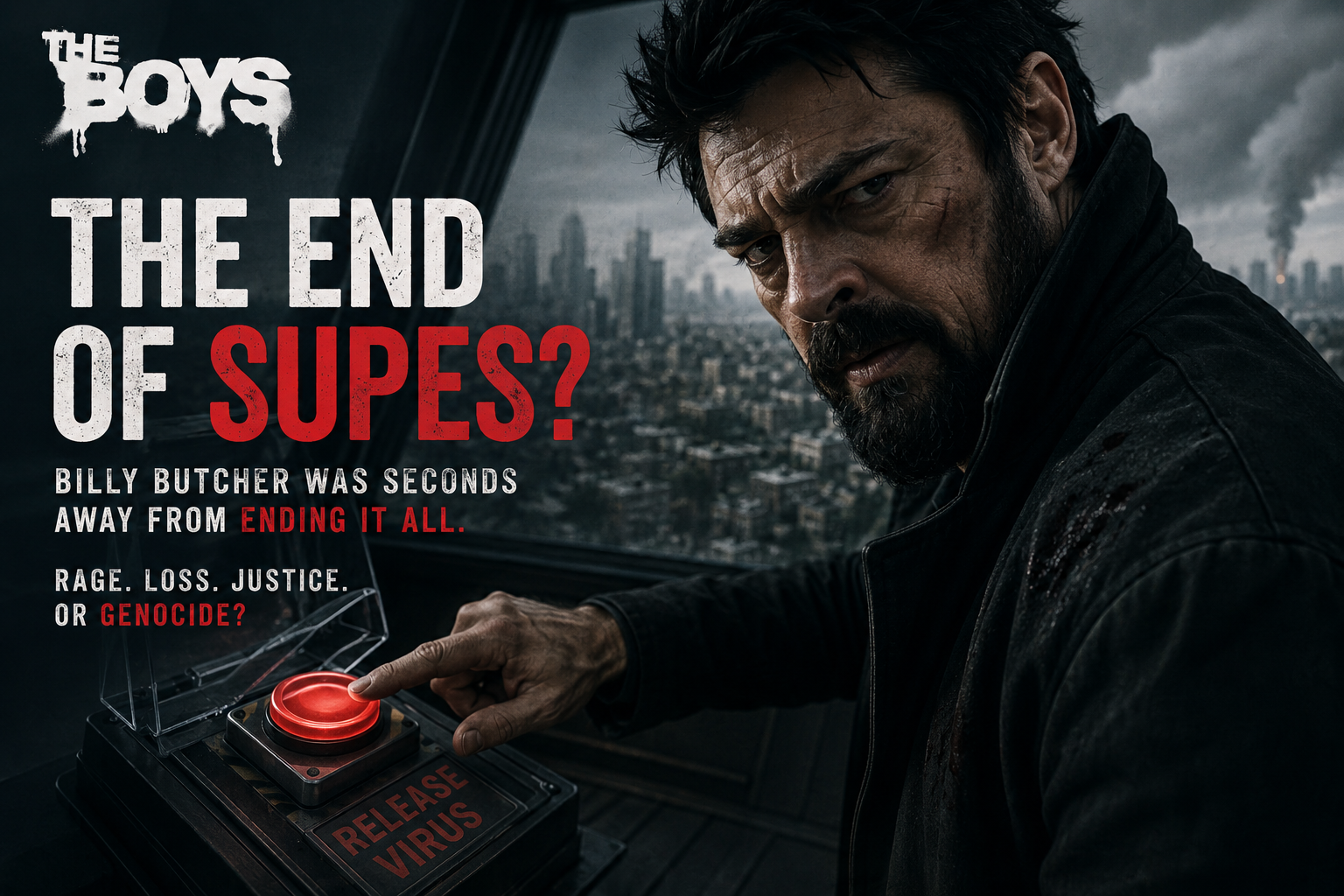
This week’s The Boys finale didn’t just close a story arc — it detonated a moral grenade. And at the center of that explosion stood Billy Butcher, making one of the most extreme decisions we’ve seen him make: releasing the supe‑killing virus.
It’s a choice the show clearly frames as monstrous. But here’s the uncomfortable truth the finale forces us to confront:
Butcher’s logic wasn’t irrational. In fact, within the world of The Boys, he might have been right.
Let’s break down why.
1. Supes Have Proven Themselves to Be an Existential Threat
By the time the finale rolls around, Butcher has watched life after life ruined and person after person killed.
Homelander nearly becomes a god‑king and they almost ran out of ideas on how to stop him, so what happens when another Homelander type supe inevitably rises up in the future?
Vought manufactures new Supes with zero oversight and maybe after what Homelander pulled this will change in The Boys universe after this point, but Butcher had no way of knowing this for sure.
Every institution meant to stop them is either corrupt or powerless and even with Stan Edgar back in control of Vought it doesn’t mean there would be proper protocols in place to stop another Homelander from happening. Stan Edgar sure didn’t stop the first Homelander from rising up.
This isn’t paranoia — it’s data. The show repeatedly demonstrates that Supes trend toward instability, narcissism, or outright tyranny, and the systems around them only amplify the danger.
With thousands of supes in The Boys universe we maybe were introduced to a dozen or so that weren’t total psychopaths.
From Butcher’s perspective, the math is simple: As long as Supes exist, humanity is one bad day away from extinction. every new supe made is basically just rolling the dice on the next Homelander rising up.
2. Killing Homelander Doesn’t Solve the Underlying Problem
Homelander’s death definitely feels like a victory but it’s really just one huge battle won not the entire war.
Vought is already rebuilding with Stan Edgar is back in the driver’s seat, and he didn’t exactly run things with humanity’s best interests at heart last time
The public is still hungry for superheroes and just like in the real-world people never really learn their lesson and as long as supes can exist and do exist the danger will always be there just waiting.
Butcher realizes something chilling: Homelander wasn’t the disease. He was a symptom.
And symptoms come back as long as the disease remains.
3. The Virus Is the Only Tool That Actually Ends the Cycle
Butcher’s worldview has always been utilitarian in the most brutal sense. He’s the kind of man who asks, “What prevents the most suffering in the long run?” — not “What feels morally clean right now?” he’s always been the one to make the hard choices others couldn’t make.
The virus offers something no other solution ever has:
- No more Supes
- No more Vought‑engineered gods
- No more Homelander 2.0 waiting in the wings
It’s a horrifying solution, but it’s also the only one that permanently removes the existential threat.
In Butcher’s mind, genocide now prevents apocalypse later.
And disturbingly, the show doesn’t give us much evidence he’s wrong.
4. Even the Smartest Supe Agrees With Him
Sage — canonically the smartest person alive — also believed the virus was the logical endpoint of the Supe problem.
When the world’s greatest strategist and the world’s most brutally honest Supe‑hunter independently arrive at the same conclusion, it forces the audience to ask:
Is this actually the only rational solution?
The finale leans into that ambiguity hard.
5. The Show Still Frames Him as Wrong — But Not Because His Logic Fails
Butcher’s mistake isn’t intellectual. It’s moral.
Releasing the virus means killing:
- Innocent Supes
- Reformed Supes
- Children
- Annie and Kimiko
And Butcher knows it. That’s why he hesitates. That’s why Hughie ultimately stops him. The show’s emotional thesis is clear:
Being right isn’t enough if the cost is your soul.
But the narrative never fully disproves Butcher’s fear. It only condemns his method.
The Uncomfortable Conclusion
Butcher’s decision is monstrous. But it’s also coherent. And in the world of The Boys, it might even be correct.
The finale leaves us with a question that lingers long after the credits roll:
If the system keeps creating gods, how long until one of them decides humanity doesn’t deserve to exist?
Butcher wasn’t willing to wait for that answer. And maybe — just maybe — he had a point.
but…If your method to defeat your enemy is worse than anything your enemy has done, then they still win in a way, don’t they?
Besides they have to leave room for spinoffs don’t they…because money…duh.




Leave a Reply